
How to Read a Peptide COA: Purity, Testing & Lab Results Explained
Disclosure: Some links in this article are affiliate links, and I may earn a commission at no extra cost to you.
You open a peptide lab report, see a big purity percentage and a few “pass” results, and think: Okay… but what am I actually looking for?
That’s what this guide is for. We’re going to look at a real COA, translate the important parts into everyday language, and talk about the results that should make you pause and ask questions.
The first thing to know: a high purity number does not tell you everything. You also need to know what was identified, how much was measured, which contamination tests were done, and whether the report actually connects to the material being discussed.
This is education about research materials. A passing COA does not make a research-use-only peptide an FDA-approved medication or establish that it is safe for human or veterinary use.
What is a COA, in plain English?
COA stands for Certificate of Analysis. It is a lab report showing what a laboratory tested in a submitted sample and what it found.
Think of it as a list of questions the lab was asked to answer. If the report only includes purity, you don’t also have answers about sterility or heavy metals. Those need their own tests.
If the basic terms are new, start with my beginner peptide guide.
Join Peppin With Rachel on Skool for beginner-friendly education and community conversations about research peptides and lab reports.
What should I look at first?
- Is this the right report? Check the compound, amount, date, and report or lot number. Ask how it connects to the material.
- What did they actually test? Find the separate results for identity, purity, amount, and any contamination tests.
- Are any results marked fail or outside a stated limit? Don’t let a high purity number distract you from a different problem.
- Is anything missing or unclear? Missing information means you don’t have an answer yet.
| On the COA | What it tells you |
|---|---|
| Identity | Whether the sample matched the expected compound using this test. |
| Purity | The intended component(s)’ share of the measured chromatography signal. |
| Quantity / content | How much of each compound was measured. |
| Heavy metals | Findings for the named metals. |
| Endotoxins | Whether the sample met the stated endotoxin criterion. |
| Sterility | Whether microorganisms grew under the test conditions. |
“Not tested,” “not detected,” and “failed” mean different things. A test that wasn’t done cannot be counted as a pass.
The real COA we’re using
This Vanguard Laboratory report is for a TB-500/BPC-157 blend labeled 10 mg, reported to GroupBuyKits.com and released August 10, 2026.
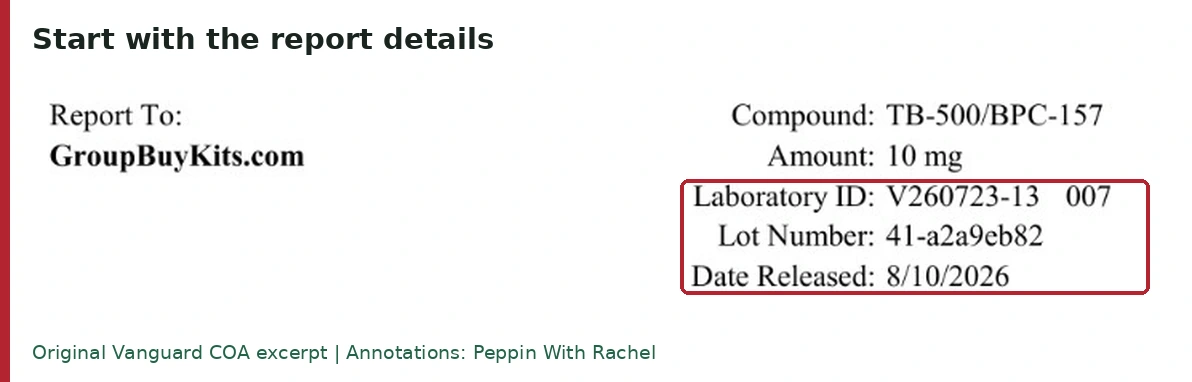
It lists report ID V260723-13 007 and lot 41-a2a9eb82. Those details identify the report. They don’t, on their own, prove that another vial came from the same material.
View original COA page 1 · View original COA page 2
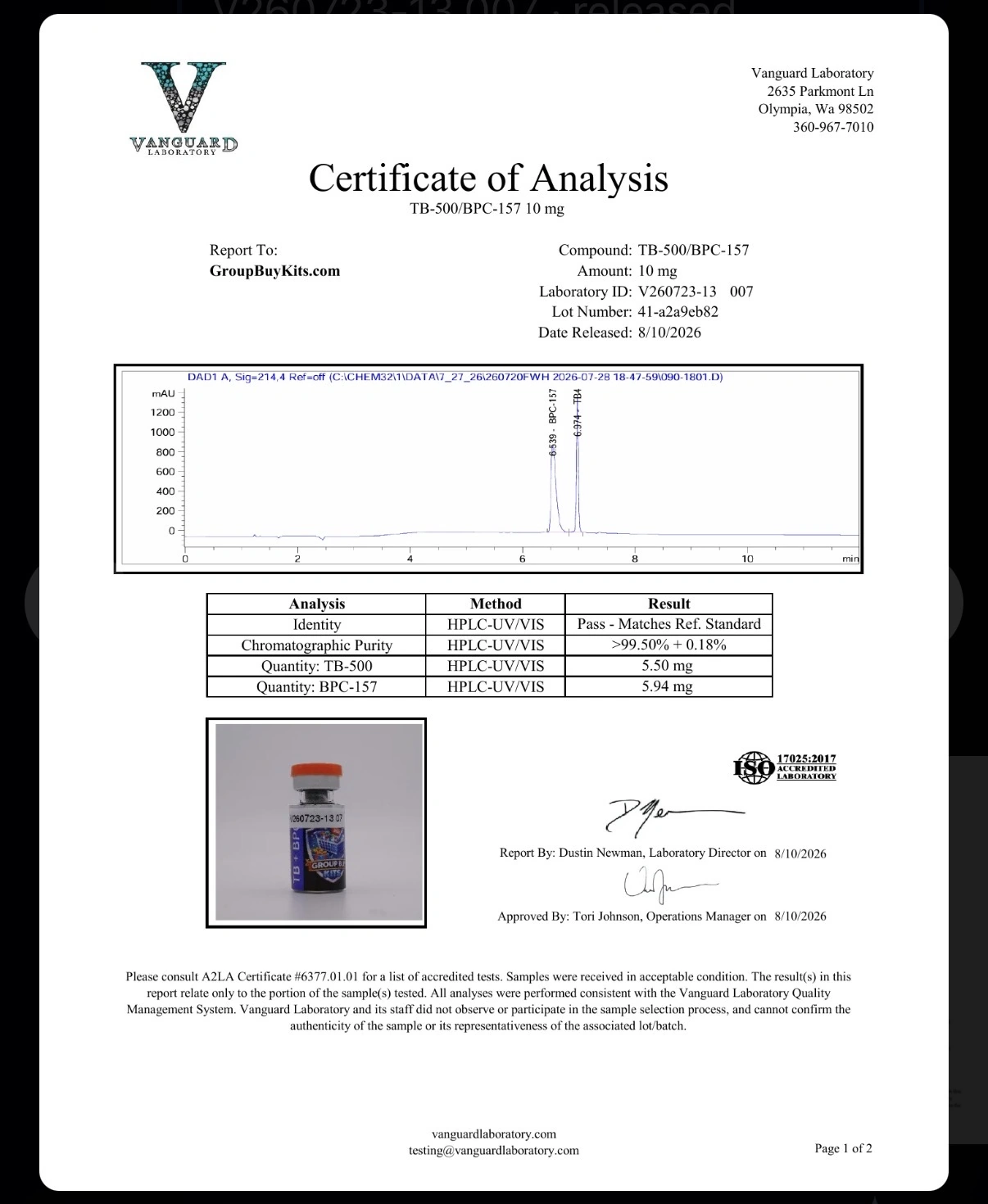
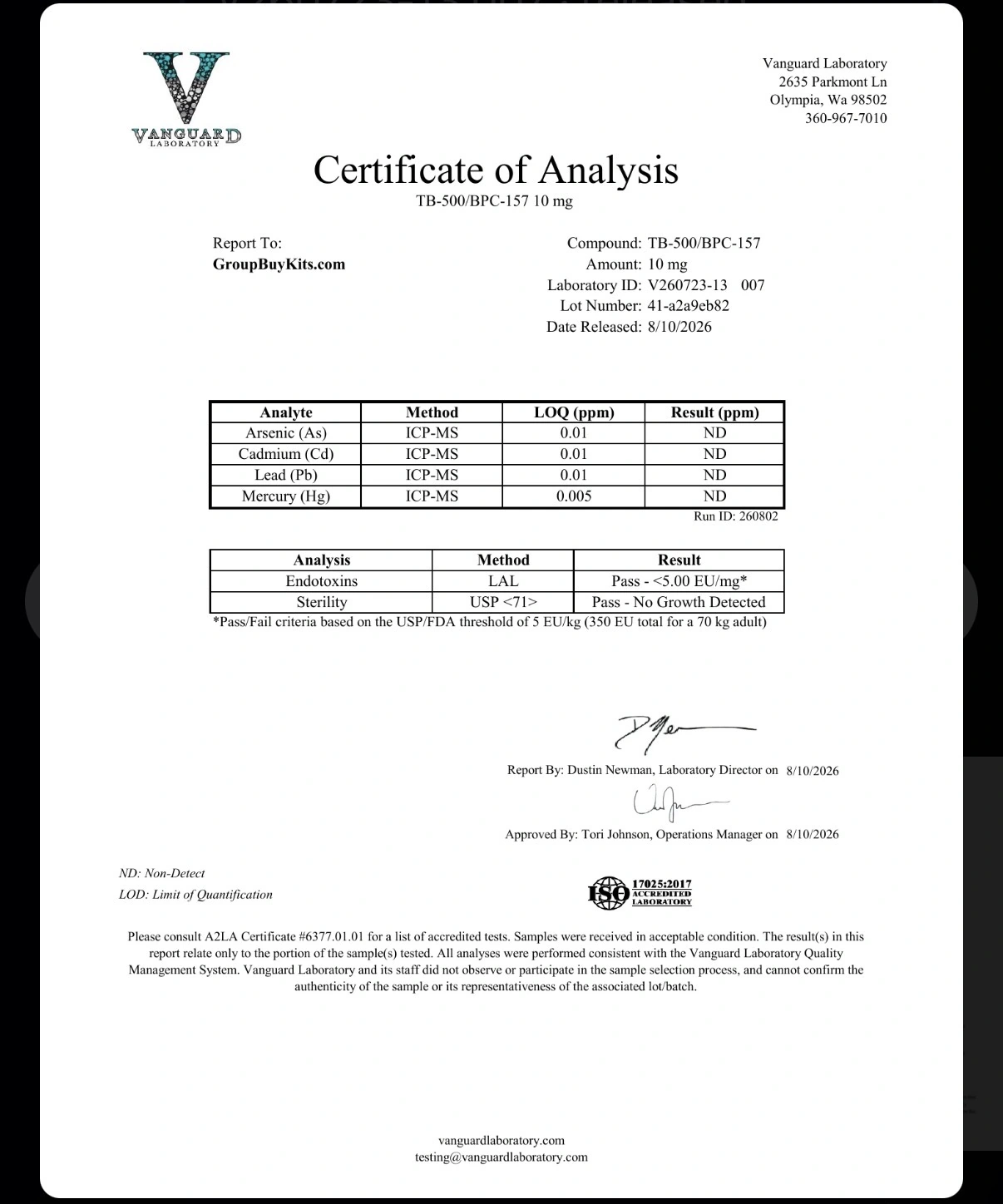
These are the original supplied images, with excerpts annotated for this guide.
1. Identity: did it match what it was supposed to be?
Start here. Before worrying about how pure something is, you want to know whether the tested sample matched the expected compound.
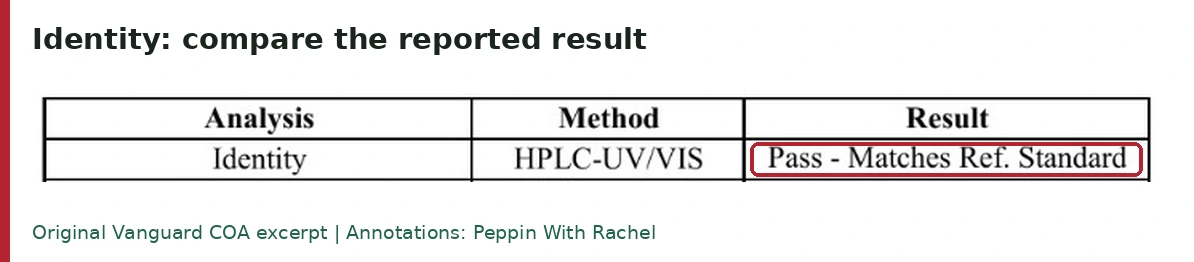
In our example: “Pass – Matches Ref. Standard.” Vanguard says the sample matched the comparison material it used for this test.
A little more detail about this example
The listed method is HPLC-UV/VIS. The report does not list mass spectrometry for this identity result. Different methods can establish different things, so ask the lab if you need confirmation of an exact molecular form.
2. Purity: don’t stop at the big percentage
Purity is usually the number people notice first. It generally describes the intended component or components’ share of the integrated signal measured under the chromatography method.

In our example: the reported purity is above 99.50%.
Purity does not tell you the number of milligrams present or replace contamination testing.
Chromatographic purity is not necessarily purity by total mass: water, salts, residual solvents, and substances the method does not detect may not be represented in that percentage.
A lower purity number doesn’t automatically mean “bad”
Purity can decrease over time as a peptide degrades. How much it changes depends on the peptide, whether it is dry or in solution, and its storage and handling conditions.
You cannot tell from the percentage alone whether age, storage, manufacturing impurities, or another factor explains a result. That requires supporting information.
Look at the lab’s interpretation and ask what specifications were set for this material and method before testing. Review storage history as context, rather than changing the acceptance criteria after seeing a result. There isn’t one universal percentage that makes every peptide “good” or “bad.” Storage history can help explain a result, but it doesn’t erase an actual failure.
About the extra notation on this report
The image prints “>99.50% + 0.18%.” The extra term is not explained. I have kept the wording as printed rather than changing the plus sign to “±.” Ask Vanguard what that term means.
3. Quantity: how much did the lab measure?
This may be called quantity, content, or assay. Look for an amount and its units—such as milligrams, written as mg. Check whether it describes a whole vial, a portion, or a concentration.
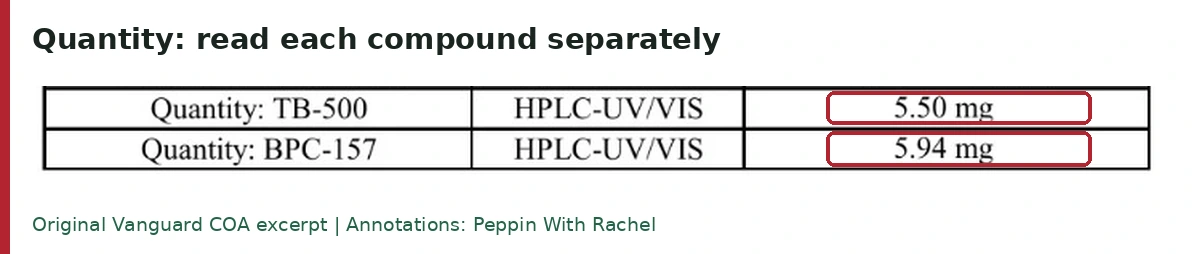
In our example: 5.50 mg of TB-500 and 5.94 mg of BPC-157. Together, that is 11.44 mg, compared with the nominal, or labeled, 10 mg total.
The reported total is 14.4% above the labeled amount: (11.44 − 10) ÷ 10 × 100.
How do you judge a difference from the label?
The amount printed on the label is the target amount. Filling variability and measurement uncertainty can contribute to differences, but the report alone does not show the cause here. An exact match to the last decimal is not something to expect from every vial.
The difference in this report is a measurement, not an explanation of why it happened. Compare results with the applicable acceptable range and ask the lab about larger or unexplained differences.
For a blend, check each ingredient as well as the total. A total alone does not show whether the ingredients are present in the expected proportions.
Your specific vial may differ from the tested vial—even within the same batch. You cannot know its exact amount from another vial’s COA. Testing material from that vial would give information about it within the test’s limits.
You can use COAs to make educated judgments about the material and its testing history. They are useful evidence, rather than an exact measurement of every vial.
99% purity and 10 mg quantity are different measurements. One cannot stand in for the other.
4. Heavy metals: what does “ND” mean?
This section looks for specific metals listed on the report. Here, those are arsenic, cadmium, lead, and mercury.
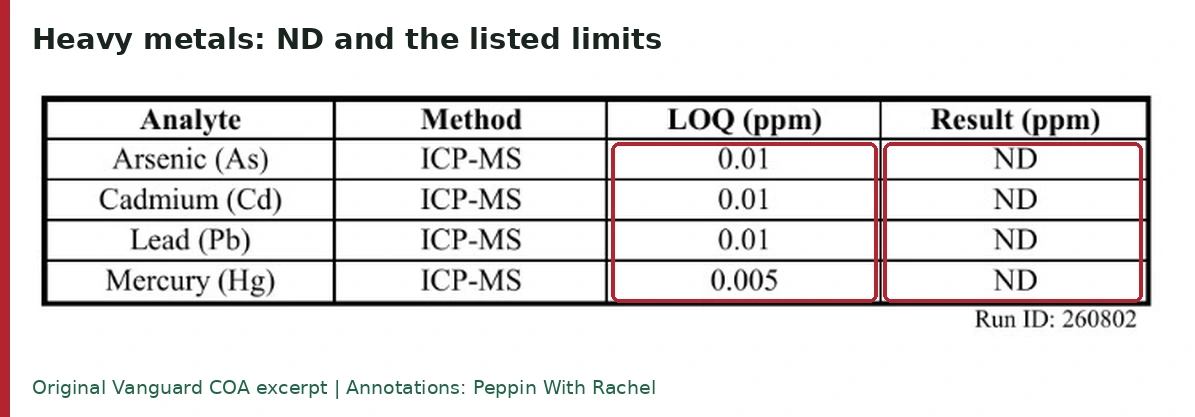
In our example: all four say ND, meaning “non-detect.” The lab did not report detecting them under its test and reporting rules. That does not prove absolute zero.
Every test has limits. LOD usually means the smallest amount it can reliably detect. LOQ usually means the smallest amount it can reliably measure as a number. FDA/ICH guidance distinguishes these limits.
The table lists LOQs of 0.01 ppm for arsenic, cadmium, and lead, and 0.005 ppm for mercury. These are measurement limits, not automatically acceptable exposure limits. The page’s abbreviation footnote appears to call “LOD” a limit of quantification even though the table says “LOQ”; ask the lab to clarify its reporting terminology.
5. Endotoxins: a separate contamination check
Endotoxins are components of certain bacteria. Testing for them is different from checking whether living microorganisms grow. A sterility result cannot replace an endotoxin result. FDA explains why these are separate tests.
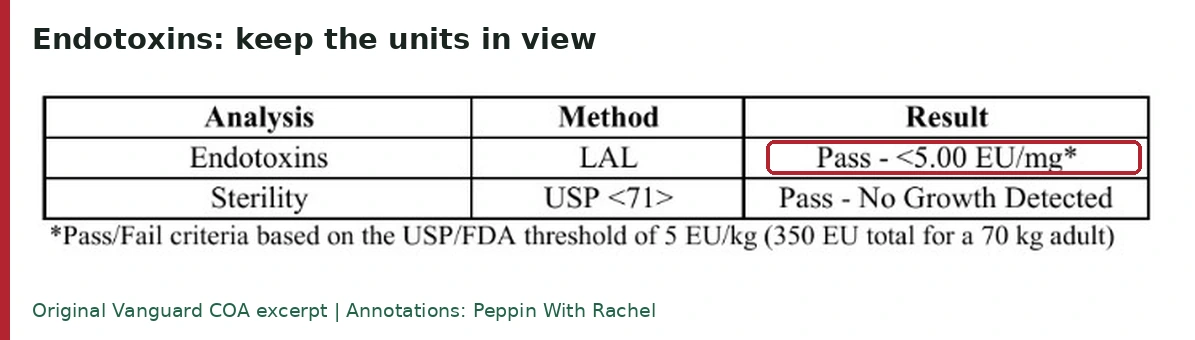
In our example: “Pass – <5.00 EU/mg.” The < sign means “less than.” EU means endotoxin units; this result is reported per milligram.
Keep the units attached. EU/mg, EU/mL, and EU/kg mean different things. You can’t compare them directly as though they are the same measurement.
The footnote here mentions a threshold in EU/kg. It does not turn the EU/mg result into a universal human-use safety limit. Appropriate limits depend on the product and context.
6. Sterility: did anything grow?
This test checks for microbial growth under the test conditions. FDA describes the limits of sterility testing.
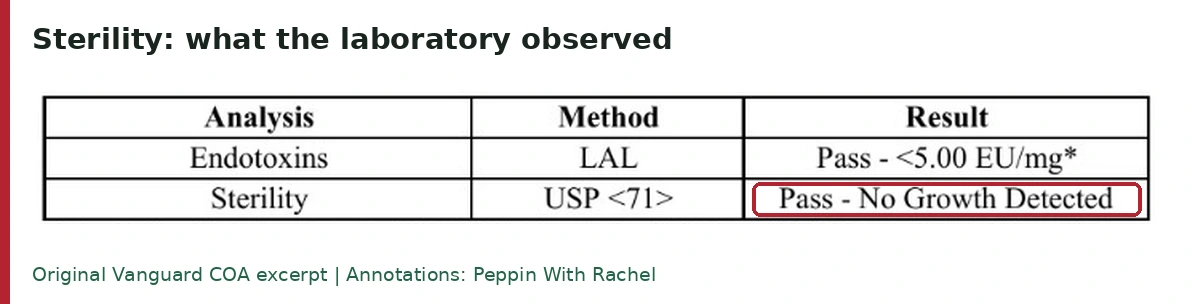
In our example: “Pass – No Growth Detected,” using USP <71>.
No growth detected is useful evidence about the tested material under those conditions. It does not prove every vial is sterile, cover all possible contamination, or guarantee what happens after storage or handling.
7. The graph: what am I looking at?
This is called a chromatogram. You don’t need to calculate anything from it to follow the report.
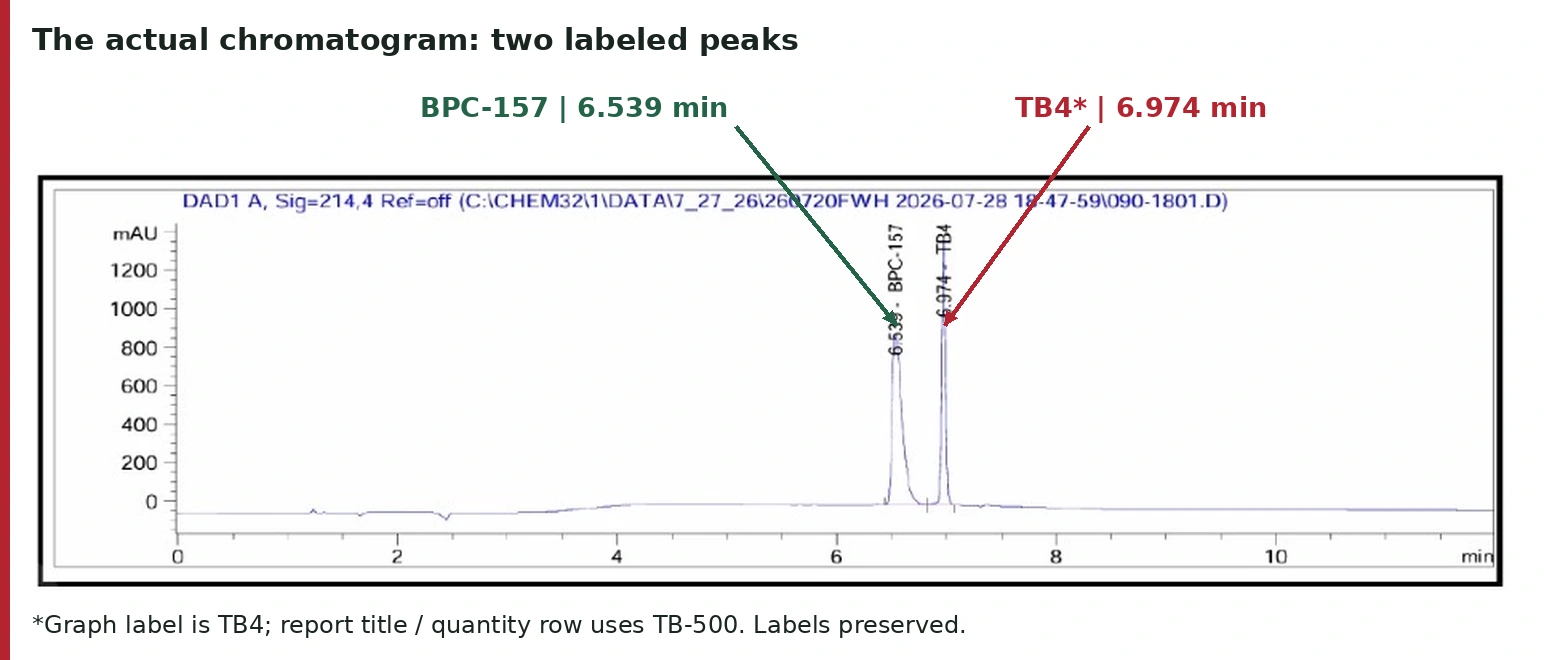
As the test separates components, the instrument records signals that appear as peaks. The bottom axis shows time; the side axis shows the strength of the detector signal.
The two main labeled peaks are BPC-157 at 6.539 minutes and TB4 at 6.974 minutes. The title and quantity row use TB-500. Ask the lab about that naming difference if the exact form matters.
A taller peak does not automatically mean more milligrams. Purity calculations commonly use the area under peaks, and different compounds can produce different signals.
COA red flags worth paying attention to
Some findings are actual failures. Others mean you need better information before drawing a conclusion.
- An identity mismatch or a failed contamination test. Read each result individually, even when another row looks good.
- A report for a different compound or an unexplained lot mismatch. Ask how it relates to the material in question.
- The same old report used with no recent ones. The date alone doesn’t prove a problem, but you want to verify they are testing frequently.
- “Fully tested” claims supported by a purity-only report. Ask to see the other results.
- A cropped screenshot that hides IDs, dates, footnotes, or other pages. Request the full report. Educational excerpts, like the ones here, should give you access to the original pages.
- No way to confirm the report with the laboratory. Use its official verification system when available, or contact it through independently obtained details.
- Conflicting values, unexplained changes, or missing units. They may reflect a mistake rather than fraud, but they still need clarification.
- “Passed, so it’s safe to inject.” A lab report does not establish that conclusion.
One odd detail is not proof of a fake. Ask for the complete report, the relevant limit, and an explanation from the lab. If a result fails, ask how it was investigated rather than treating a later passing result as if the failure never happened.
The part people miss: this is a sample result
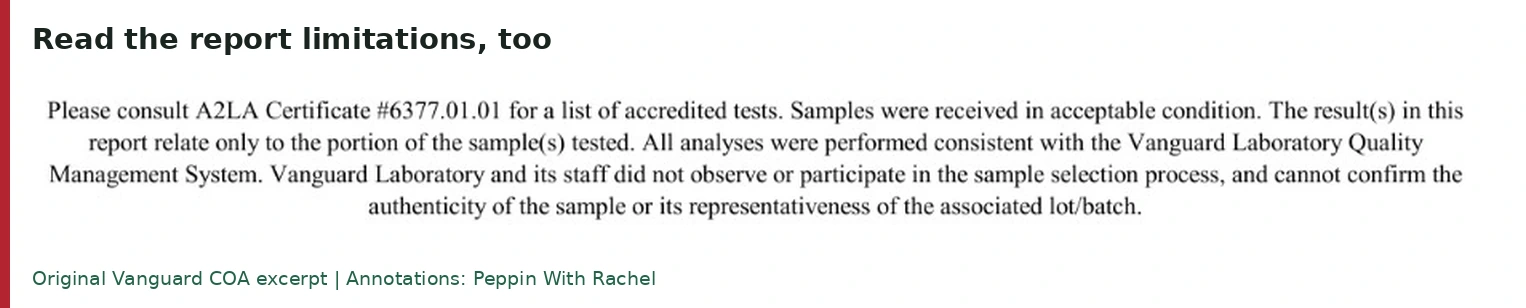
Vanguard’s report says the results apply to the tested portions. It also says the lab did not participate in sample selection and cannot confirm that the sample represents the associated lot or batch.
In everyday language: the lab tested what it received. It did not test every vial someone might connect to this report.
Applying the findings to other vials depends on how the sample was selected, where it came from, and how well that connection is documented.
So, what makes a COA useful?
You can identify the report, connect it to the material, see what was tested, understand the results and limits, and get answers about anything unclear.
A pass means the lab says a particular test met its criterion. It does not mean every possible test was done. Here, identity, endotoxins, and sterility carry pass wording; purity and quantity are reported as measurements.
A COA also does not establish FDA approval, clinical effectiveness, or human-use safety. Research peptides also have important gaps in human safety information.
For more context about the platform behind this teaching example, read my GBK Group Buy Kits review. My tools and guides collect the other resources on this site.
Why testing matters in the places I choose
GBK, Southern Aminos, and Trulixir are my chosen peptide suppliers. Access to lab reports is one of the things I look at when evaluating a supplier.
- GBK (GroupBuyKits) — use my referral link; no discount code needed.
- Southern Aminos — code PEPPINWITHRACHEL.
- Trulixir Peptides — code Rachel10 for 10% off.
Their testing programs are not necessarily identical. I still look at the actual report for the material in question: what was tested, when it was tested, and what the results say. Frequent testing can build a more useful history, but it does not make every vial identical.
Your quick COA checklist
- Right report? Name, amount, date, ID, and connection to the material.
- Right identity? Look for an actual identity result.
- Purity and amount? Read both, and check every ingredient in a blend.
- Contamination results? Check metals, endotoxins, and sterility individually when those tests are claimed.
- Anything failed, missing, or confusing? Ask about it.
- Full report available? Include all pages and footnotes.
You don’t need to memorize every abbreviation. You need to know what questions the report answers—and which ones are still unanswered.